GEOTECHNICALENGINEERING
VANCOUVER
HomeLaboratoryGrain size analysis (sieve + hydrometer)

Grain Size Analysis (Sieve + Hydrometer) in Vancouver

Knowledgeable. Thorough. Resourceful.

LEARN MORE

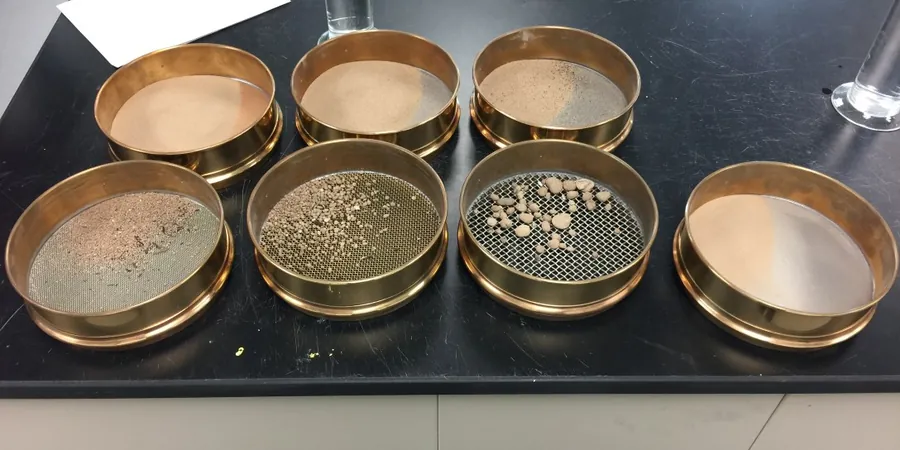
In Vancouver, we often see grain size distributions that look textbook but behave differently in the field. A clean-looking sand from the Quadra unit can carry 6–8% silt that cuts permeability by an order of magnitude — and that shows up fast once excavation hits the water table. Our lab runs the full stack: mechanical sieving plus hydrometer sedimentation per ASTM D422 and D6913, so the PSD curve doesn't miss the fines tail. The data feeds straight into USCS classification, frost-susceptibility checks, and filter compatibility for retaining structures. When the project site sits on Vashon till with cobble-sized clasts, we coordinate with the field crew to capture the oversize fraction because ignoring it skews the whole curve upward. For deeper glaciomarine silts, the Atterberg limits lab run on the same split sample gives the plasticity index needed to confirm whether those fines are actually clay or just rock flour that drains reasonably well.

A three-point hydrometer curve on Vancouver's glaciomarine silt can shift the USCS classification from SM to ML — and that single letter changes the allowable bearing pressure under NBCC 2015.
Our service areas

Methodology and scope

Vancouver's soil column is rarely simple. A single borehole can pass through Capilano sediments, advance into Vashon till, and bottom out in pre-Vashon silts — three distinct gradation signatures in 20 metres. Our sieving protocol starts with a full wash through the No. 200 sieve, oven-dried at 110°C, then stacked from 4.75 mm down to 75 µm. The hydrometer leg uses sodium hexametaphosphate dispersion with readings at 0.5, 1, 2, 4, 8, 15, 30, 60, 120, and 1440 minutes, corrected for temperature and meniscus per ASTM D422. Where the sample contains organics — common near Still Creek or False Creek flats — we pre-treat with hydrogen peroxide to avoid flocculation that masks the true clay fraction. The combined curve gets plotted on a semi-log graph with D10, D30, D50, and D60 extracted directly. Those values become the inputs for Hazen's permeability estimate, the USCS group symbol, and the internal stability assessment required when designing filters for retaining walls in the city's high-groundwater neighborhoods. For road subgrade work, we also check the percent passing 0.075 mm against the MoTI granular base specification — anything above 8% fines usually triggers a plasticity review before the material gets approved.
Grain Size Analysis (Sieve + Hydrometer) in Vancouver
Technical reference — Vancouver

Local considerations

Vancouver's development pattern — dense mid-rise on glacial till, towers on deep drift, light industrial on Fraser River alluvium — means gradation mistakes cascade differently in each zone. A misclassified silty sand in a Kitsilano excavation can turn a designed 0.6 m sump into an undersized pit that clogs within hours. On the Fraser delta, missing a 15% clay fraction in a deposit assumed to be clean sand leads to settlement predictions that are off by years, not millimetres. The NBCC 2015 and the upcoming 2025 edition both tie site classification to soil properties that start with the PSD curve: liquefaction susceptibility, Site Class C vs D boundaries, and lateral earth pressure profiles all depend on knowing whether the material is truly granular or cohesive. Even in routine trench backfill, skipping the hydrometer on a borrow source that looks sandy can result in imported fill that fails compaction spec because the fine fraction holds water and prevents reaching 95% modified Proctor. When the gradation data is incomplete, the risk isn't theoretical — it shows up as construction delays, re-testing costs, and EOR sign-off refusals that no one budgets for.

Need a geotechnical assessment?

Reply within 24h.

Email: contact@geotechnicalengineering.vip

Applicable standards

ASTM D422-63(2007): Standard Test Method for Particle-Size Analysis of Soils (Hydrometer), ASTM D6913/D6913M-17: Standard Test Methods for Particle-Size Distribution (Gradation) of Soils Using Sieve Analysis, ASTM D7928-17: Standard Test Method for Particle-Size Distribution of Fine-Grained Soils Using the Sedimentation (Hydrometer) Analysis, NBCC 2015 Division B, Section 4.2: Soil classifications tied to USCS for foundation design, CSA A23.2-1A: Sieve analysis of fine and coarse aggregate (where testing concrete sand or base course)

Technical parameters

ParameterTypical value
Test standard (sieve)ASTM D6913 / CSA A23.2-1A
Test standard (hydrometer)ASTM D422 / D7928
Sieve range75 mm to 75 μm (No. 200)
Hydrometer particle range75 μm down to 1 μm
Dispersion agentSodium hexametaphosphate (NaPO3)6
Organic matter pretreatmentH2O2 digestion per ASTM D422
Reporting parametersD10, D30, D50, D60, Cu, Cc, %gravel/sand/silt/clay
Sample mass (minimum)200 g for hydrometer split, 500 g total

Frequently asked questions

How much does a grain size analysis with hydrometer cost in Vancouver?

A full sieve-plus-hydrometer package on one sample runs CA$130 to CA$260, depending on whether pretreatment for organics is needed and how many hydrometer points the engineer specifies. Rush turnaround at 24 hours carries a small surcharge. Volume pricing applies when submitting five or more samples from the same project.

When does Vancouver's glacial till require a hydrometer instead of just a sieve analysis?

Any till sample with more than 12% passing the No. 200 sieve should go to hydrometer. Vancouver's Vashon till matrix often holds 15–25% silt and clay from glacial grinding; without the sedimentation leg, the fines fraction is just a single wash-loss number that tells you nothing about the clay-versus-silt split. That split controls permeability, frost susceptibility, and whether the till is SC or SM — which directly affects Site Class assignment under NBCC.

What dispersion protocol do you use for hydrometer testing?

We follow ASTM D422 with sodium hexametaphosphate at 40 g/L concentration, mixed in a mechanical stirrer for one minute. Temperature is maintained at 20°C ± 1°C in a constant-temperature bath, and each hydrometer reading is corrected for meniscus and temperature. For samples with visible organic content, we pre-treat with hydrogen peroxide before dispersion to eliminate flocculation that would bias the clay fraction high.

Can you run grain size analysis on samples with cobbles and boulders?

Yes, but it requires field coordination. The lab sieves up to 75 mm; material retained above that is weighed in the field or at our yard and reported as the oversize fraction. We then correct the entire gradation curve so the percent-passing values reflect the total sample mass, not just the lab-sieved portion. This is essential in Vancouver's North Shore tills where cobble content regularly exceeds 20%.

Location and service area

We serve projects across Vancouver and its metropolitan area.

View larger map