GEOTECHNICALENGINEERING
VANCOUVER
HomeSeismicSoil liquefaction analysis

Soil Liquefaction Analysis in Vancouver: Technical Protocols for Earthquake-Resistant Design

Knowledgeable. Thorough. Resourceful.

LEARN MORE

A cone penetration test (CPT) rig advancing through the soft deltaic deposits of Richmond or Delta reveals more than just stratigraphy — it uncovers the liquefaction susceptibility that defines geotechnical design in Vancouver. Our team deploys seismic CPT (SCPTu) equipment capable of recording pore pressure dissipation and shear wave velocity in a single push, a methodology that has become standard practice for projects east of the Coast Mountains. We correlate the normalized tip resistance and friction ratio with the cyclic resistance ratio (CRR) using the updated Boulanger & Idriss (2014) framework, rather than relying on older SPT-based charts that tend to overestimate resistance in the fine-grained sands of the Fraser River floodplain. In our experience, the local geology demands this level of precision — interbedded silts and clean sands respond very differently to cyclic loading, and a mischaracterized layer can compromise an entire foundation design. When site conditions require supplementary data, we pair the CPT program with MASW surveys to determine VS30 for site classification, and in coarser deposits we use SPT drilling to recover disturbed samples for grain-size verification, ensuring the fines content correction is grounded in physical evidence rather than assumed correlations.

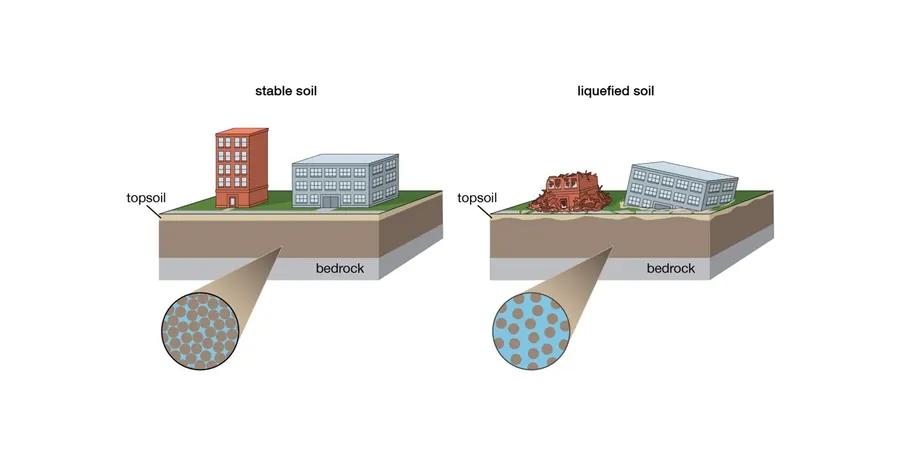
Liquefaction in Vancouver's deltaic soils is not a binary 'yes or no' — it demands a probabilistic assessment that accounts for the full earthquake magnitude, distance, and site-specific ground motion amplification.
Our service areas

Methodology and scope

A recurring mistake we see in Vancouver's competitive construction market is the assumption that a project is exempt from liquefaction assessment simply because it sits outside the official floodplain — a dangerous shortcut that has led to costly foundation retrofits in neighborhoods like Kerrisdale and Marpole. The reality is that loose Pleistocene sands and artificial fill deposits exist across much of the city, and the NBCC 2020 mandates a site-specific seismic hazard evaluation for all buildings classified as post-disaster or high-importance. Our approach begins with a detailed review of the geologic setting: we map the depth to the water table (often within 1.5 meters of grade in areas south of False Creek), identify potentially liquefiable layers using the soil behavior type index (Ic), and calculate the factor of safety against liquefaction at multiple depths. For projects involving deep foundations, this analysis feeds directly into downdrag estimates and lateral load demands on piles. We integrate the findings with slope stability modeling when the site is adjacent to the North Shore escarpment or the Point Grey cliffs, where seismic ground deformation can trigger flow failures even in soils that would otherwise be considered marginally liquefiable. In cases where the calculated settlements exceed the project's tolerance, we work with the design team to evaluate ground improvement strategies such as stone columns or vibro-compaction, always tying the performance specifications back to the post-treatment CPT verification results.
Soil Liquefaction Analysis in Vancouver: Technical Protocols for Earthquake-Resistant Design
Technical reference — Vancouver

Local considerations

The contrast between Vancouver's dry summer months and its rain-saturated winter season creates a liquefaction risk profile that shifts throughout the year. From October through March, the water table rises to within a meter of the surface across much of the Fraser River delta, effectively saturating the loose sand units that would otherwise remain partially drained during a seismic event. We have observed this seasonal variation produce a 15 to 20 percent reduction in the factor of safety against liquefaction when comparing CPT data from August and January at the same test location in Richmond. The implications go beyond academic interest: a design that relies on summer groundwater measurements without accounting for the winter high stands can severely underestimate the cyclic stress ratio, particularly for shallow foundations within the top 5 meters. In the event of a Cascadia subduction zone earthquake — a magnitude 9.0 scenario that Vancouver's seismic design spectrum explicitly incorporates — the duration of strong shaking would be measured in minutes rather than seconds, drastically increasing the pore pressure buildup and the likelihood of flow liquefaction in the loose Fraser River sands. This is not speculative; paleoliquefaction features documented by Clague and others along the Fraser River delta confirm that large prehistoric events have triggered widespread ground failure in the very deposits we build on today, making a defensible liquefaction analysis an essential component of any responsible project in the Lower Mainland.

Need a geotechnical assessment?

Reply within 24h.

Email: contact@geotechnicalengineering.vip

Applicable standards

NBCC 2020 (National Building Code of Canada, Seismic Provisions), NCEER/NSF Workshop (Youd & Idriss 2001) — Liquefaction Resistance of Soils, ASTM D5778-20 — Standard Test Method for Electronic Friction Cone and Piezocone Penetration Testing, ASTM D6913/D6913M-17 — Particle-Size Distribution (Gradation) of Soils Using Sieve Analysis, CSA A23.3-19 — Design of Concrete Structures (seismic detailing), Boulanger, R.W. & Idriss, I.M. (2014) — CPT and SPT Based Liquefaction Triggering Procedures

Technical parameters

ParameterTypical value
Analysis frameworkBoulanger & Idriss (2014) CPT-based; Youd et al. (2001) SPT-based
Seismic demandNBCC 2020 uniform hazard spectrum; site class per Table 4.1.8.4
Triggering assessmentCyclic Stress Ratio (CSR) vs. Cyclic Resistance Ratio (CRR) per depth interval
Fines content correctionLaboratory grain-size analysis (ASTM D6913) on SPT or thin-wall tube samples
Post-liquefaction settlementZhang, Robertson & Brachman (2002) CPT method; Ishihara & Yoshimine (1992) for SPT
Lateral spreading displacementYoud et al. (2002) empirical model; site-specific Newmark analysis where applicable
Residual strength ratioOlson & Stark (2002) correlation to equivalent clean sand SPT blow count
Reporting standardGeotechnical design report with site class, FS profiles, and settlement contours

Frequently asked questions

What is the approximate cost of a soil liquefaction analysis for a typical single-family home project in Vancouver?

For a standard residential lot in Vancouver, a complete liquefaction assessment — including CPT sounding, groundwater monitoring, laboratory grain-size analysis, and a signed geotechnical report — typically falls in the range of CA$3,610 to CA$6,160. The final cost depends on the number of CPT soundings required (a single sounding is sufficient for a uniform site, while two are recommended where lateral variability is suspected), the depth of investigation (generally 20 meters for a two-story structure), and whether cyclic laboratory testing is needed. Sites with difficult access, such as rear-yard areas with limited overhead clearance, may require a mini-CPT rig that can add to the mobilization cost.

How does Vancouver's NBCC 2020 seismic hazard differ from what was used in the 2015 code, and why does it matter for liquefaction analysis?

The NBCC 2020 introduced updated seismic hazard values for Vancouver based on the 6th Generation Seismic Hazard Model of Canada, which incorporates a refined understanding of the Cascadia subduction zone and crustal faults. The uniform hazard spectrum for a 2,475-year return period now shows higher spectral accelerations at periods of 0.2 to 1.0 seconds compared to the 2015 code, which directly increases the cyclic stress ratio (CSR) used in the liquefaction triggering calculation. Additionally, the site classification procedure now requires a more rigorous determination of the average shear wave velocity in the top 30 meters (VS30), meaning that a generic site class D assumption is no longer defensible for projects where site-specific measurement is feasible.

What are the most common liquefaction mitigation techniques used for projects in the Fraser River delta?

In our experience across Vancouver, Richmond, and Delta, the most frequently adopted mitigation strategies are vibro-replacement stone columns and vibro-compaction — both of which densify the loose granular soils and provide drainage paths that limit pore pressure buildup during shaking. For sites with fine-grained interbeds where vibratory methods are less effective, deep soil mixing or compaction grouting may be specified. The choice of technique depends on the depth of the liquefiable layer, the required post-treatment penetration resistance, and the settlement tolerance of the structure. We always confirm the effectiveness of the treatment through pre- and post-improvement CPT testing, with acceptance criteria tied explicitly to the factor of safety against liquefaction and the predicted settlement under the design earthquake.

Location and service area

We serve projects across Vancouver and its metropolitan area.

View larger map