GEOTECHNICALENGINEERING
VANCOUVER
HomeIn-Situ TestingField density test (sand cone method)

Field Density Testing (Sand Cone Method) in Vancouver: Reliable Compaction Control

Knowledgeable. Thorough. Resourceful.

LEARN MORE

Vancouver's relentless rain and glacially overconsolidated soils create a compaction paradox that catches many contractors off guard. You can run a sheepsfoot roller all day, but if the moisture content in your fill shifts by two percent after a November storm, the density numbers fall apart. We see it constantly on sites from the Fraser River delta to the North Shore cut slopes. The sand cone test (ASTM D1556) gives us a direct, physical measurement of in-place density that nuclear gauges sometimes misread in these variable near-surface materials. Because so much of metro Vancouver sits on ablation till with cobbles and boulders, the sand cone method often outperforms other field density techniques when the gradation gets coarse. We combine it with Proctor testing in our Surrey lab to establish the maximum dry density reference curve, then field-verify compaction right on your lift before the next layer goes down.

A 95% Proctor specification means nothing without knowing whether the reference curve was run on the same material you actually placed.
Our service areas

Methodology and scope

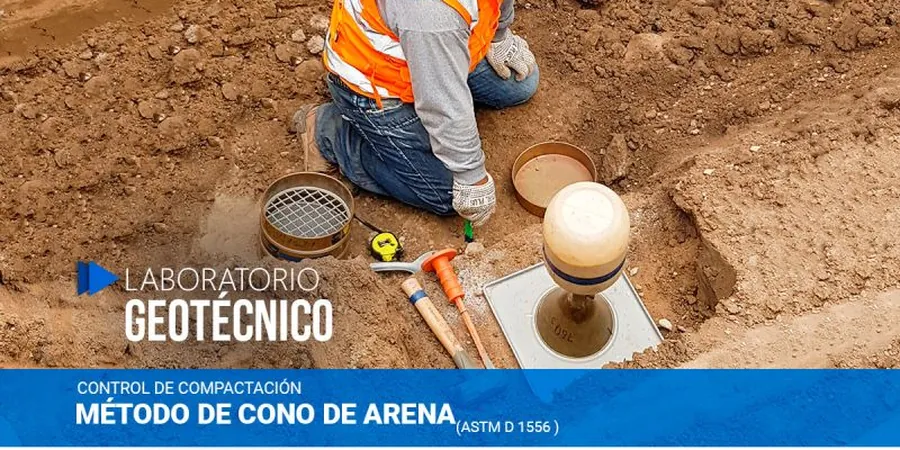
A common mistake on Vancouver multifamily projects is accepting density readings from the top of a lift without checking what is happening 150 mm below the surface. Glacial till in this region typically contains silt seams that trap water, so the upper crust dries out and looks well compacted while the underlying material remains loose and saturated. Our field team runs the sand cone test at the actual depth of the compaction effort, not just the surface skin. The procedure excavates a clean hole approximately 150 mm in diameter, weighs every gram of removed soil, and backfills the cavity with calibrated Ottawa sand to measure the precise volume. From there we calculate wet density, then oven-dry a representative portion to determine moisture content and dry density, finally comparing against the lab Proctor curve. For deep utility trenches in Vancouver's till, these numbers often reveal compaction gaps that a nuclear gauge would miss because of the cobble content. We routinely pair field density verification with grain size analysis to confirm that the fill material matches the approved borrow source specification before compaction even begins.
Field Density Testing (Sand Cone Method) in Vancouver: Reliable Compaction Control
Technical reference — Vancouver

Local considerations

The City of Vancouver sits on a geological patchwork where a 2-meter change in elevation can shift you from dense till to compressible marine clay. In 2011, seismograph upgrades across the Georgia Basin confirmed that the underlying glacial sediments amplify ground motion differently block by block, which means fill compaction directly influences differential settlement during a seismic event. Poorly compacted backfill behind a retaining wall in Kitsilano behaves completely differently than the same fill placed on a bedrock bench in Burnaby. When field density tests are skipped or done with the wrong method, the failure mode is almost always delayed: pavement sagging two winters later, a foundation corner settling into an old utility trench, or a parkade slab cracking as the underslab fill consolidates under traffic loads. We use the sand cone test because it provides a physical volume measurement independent of the material's chemical composition, something that matters enormously in Vancouver where fill sources range from crushed granodiorite to recycled concrete aggregate.

Need a geotechnical assessment?

Reply within 24h.

Email: contact@geotechnicalengineering.vip

Explanatory video

Applicable standards

ASTM D1556-15e1: Standard Test Method for Density and Unit Weight of Soil in Place by Sand-Cone Method, ASTM D698-12e2: Standard Test Methods for Laboratory Compaction Characteristics of Soil Using Standard Effort, BC Building Code 2024, Division B, Part 4 (geotechnical provisions referencing NBCC 2020), MMCD (Master Municipal Construction Documents) Section 31 23 33 for trench backfill compaction in Greater Vancouver

Technical parameters

ParameterTypical value
Standard methodASTM D1556 / AASHTO T 191 (sand cone apparatus)
Test depth range150–200 mm typical; deeper with extension cones
Calibration sandASTM C778 20–30 Ottawa sand, bulk density verified daily
Minimum test hole volume850 cm³ for max particle size 25 mm
Moisture determinationOven-dried at 110±5°C per ASTM D2216
Typical specification reference95% or 98% of ASTM D698 maximum dry density
Applicable fill typesGranular, silty sand, lean clay, crushed aggregate base

Frequently asked questions

How much does a field density test using the sand cone method cost in Vancouver?

For sites within Metro Vancouver, a single sand cone field density test typically runs between CA$140 and CA$220 per test point, depending on travel distance from our Surrey lab, the number of tests scheduled on the same visit, and whether we also need to run a companion Proctor on your fill material. Mobilization is often waived when you book five or more tests in one day. We recommend bundling tests to keep the per-unit cost at the lower end of that range.

How soon after compaction can you run the sand cone test?

The test can be performed immediately after the compactor passes. There is no waiting period like with some nuclear methods. We excavate the hole, bag the entire removed material, pour the calibrated sand, and measure the volume on the spot. You get the wet density number within minutes, and the final dry density and percent compaction within 24 hours once the moisture sample finishes oven drying at our lab.

Does the sand cone method work with the coarse glacial till we find all over Vancouver?

Yes, and that is actually one of the main reasons we use it here. The ASTM D1556 method works well in soils containing particles up to 50 mm, which covers most of the ablation till and weathered granodiorite encountered on the North Shore and across South Vancouver. When the fill contains larger cobbles, we use a larger excavation hole and a replacement sand volume calibrated for the coarser matrix. The physical volume measurement avoids the chemistry-dependent errors that can affect nuclear gauges in high-iron glacial soils.

What moisture condition does the fill need to be in for a valid sand cone test?

The fill should be at or near its optimum moisture content, but the test works across a wide range. Vancouver's wet season creates a practical problem: if the excavation hole walls collapse or groundwater seeps in during the test, the volume measurement is compromised. Our technicians carry portable shelters and can work in light rain, but standing water in the test zone requires dewatering or waiting for conditions to improve. We always record the field moisture and flag tests where the water content exceeds the optimum by more than three percent.

How does the sand cone test compare to a nuclear density gauge for Vancouver municipal work?

The sand cone test is the reference method specified in the MMCD documents for compaction acceptance on municipal infrastructure. Nuclear gauges are faster for production testing, but the local standard requires correlation through side-by-side sand cone tests. On Vancouver projects with coarse glacial fill, sand cone results are often more reliable because the physical volume measurement does not depend on the hydrogen content or iron chemistry of the soil matrix, which can skew nuclear gauge readings in till.

Location and service area

We serve projects across Vancouver and its metropolitan area.

View larger map