GEOTECHNICALENGINEERING
VANCOUVER
HomeFoundationsPile foundation design

Pile Foundation Design in Vancouver: Deep Load Transfer for West Coast Conditions

Knowledgeable. Thorough. Resourceful.

LEARN MORE

A 25-storey tower on the Broadway corridor hits refusal at 18 meters, right where dense Vashon till masks a deeper compressible layer. That is the kind of profile we see weekly in Vancouver. Pile foundation design here is not about copying a standard detail; it is about reconciling the National Building Code of Canada with site-specific stratigraphy that can shift from Fraser River sand to Capilano sediments within a single city block. We combine SPT drilling data with laboratory strength tests to define shaft friction and end bearing capacity, then model the pile group under the seismic envelope required by NBCC 2015. The result is a foundation that transfers structural loads past the problematic upper soils and into competent bearing strata, whether that is glacial till at 15 meters or bedrock at 35. Every pile design we deliver in Vancouver accounts for downdrag potential in soft clay pockets and lateral spreading risk in sandy zones, two mechanisms that have shaped the city's geotechnical practice since the 1964 Alaska earthquake underscored what a Cascadia event could do here.

In Vancouver, pile design is seismic design. If you are not checking lateral spreading against the pile group, you are missing the controlling load case.
Our service areas

Methodology and scope

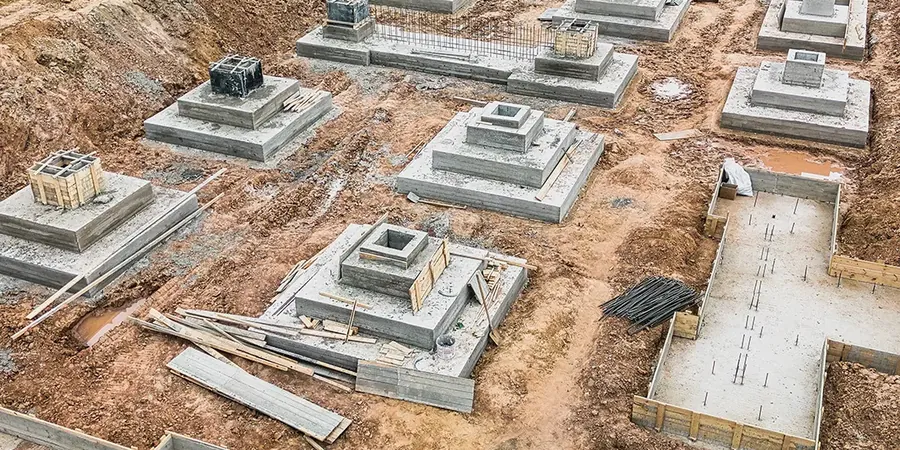
We specify driven steel H-piles, closed-end pipe piles, and cast-in-place drilled shafts depending on access, noise restrictions, and soil conditions on the Vancouver site. Steel H-piles work well through dense granular soils and can be driven to high capacity, while drilled shafts with temporary casing handle the cobbly till without excessive vibration—a real advantage in residential neighborhoods from Kitsilano to Mount Pleasant. Our designs follow CSA A23.3 for concrete strength and ASTM D3966 for lateral load testing, with pile capacities verified through PDA (Pile Driving Analyzer) monitoring during installation. When the upper 10 to 15 meters contain liquefiable Fraser River sands, we extend piles below the critical depth and evaluate lateral spreading demands using NCEER methodology. The interaction between pile group stiffness and the surrounding soil is modeled in LPILE or GROUP, and we incorporate site-specific liquefaction analysis results directly into the p-y curves. For projects where settlement control is tighter—hospitals, data centers, or laboratory buildings—we pair deep piles with grade beams designed to span between pile caps, creating a rigid load path that limits differential movement to less than 10 millimeters under the design earthquake.
Pile Foundation Design in Vancouver: Deep Load Transfer for West Coast Conditions
Technical reference — Vancouver

Local considerations

Vancouver's urban footprint expanded rapidly across the Fraser River delta after the 1950s, pushing development onto thick sequences of soft silts and saturated sands that had previously been agricultural land. The geotechnical consequence is that many sites in Richmond, South Vancouver, and along the Fraser arms are underlain by 10 to 20 meters of liquefiable material. A pile foundation designed without explicit liquefaction analysis can lose lateral support during shaking, buckling or shearing at the interface between the liquefied layer and the overlying crust. We have reviewed older buildings in the city where pile caps were placed above the liquefiable horizon, leaving the piles unsupported over a free length of several meters—a condition that modern NBCC provisions explicitly require designers to avoid. The seismic microzonation maps published by the City of Vancouver and the Geological Survey of Canada now guide site classification, but microzonation alone does not replace a project-specific assessment. When we design piles for a site near the Oak Street Bridge or along Marine Drive, we run site response analysis to confirm the design spectrum, then check axial and lateral performance at every layer boundary where a stiffness contrast could concentrate strain during a Cascadia subduction event.

Need a geotechnical assessment?

Reply within 24h.

Email: contact@geotechnicalengineering.vip

Applicable standards

NBCC 2015 – Structural and seismic design provisions, CSA A23.3 – Design of concrete structures (pile caps, drilled shafts), ASTM D3966 – Standard test methods for deep foundations under lateral load, ASTM D1143 – Standard test methods for deep foundations under static axial compressive load, NCEER (Youd & Idriss, 2001) – Liquefaction resistance and lateral spreading assessment

Technical parameters

ParameterTypical value
Design code basisNBCC 2015, CSA A23.3, AASHTO LRFD (bridges)
Pile types specifiedDriven steel H, closed-end pipe, drilled shafts, CFA piles
Typical pile lengths in Vancouver15–45 m depending on till/bedrock depth
Lateral load analysisLPILE / GROUP, p-y curves with liquefaction reduction
Axial capacity verificationPDA monitoring, static load test (ASTM D1143)
Seismic demandSite Class C/D/E per NBCC, 2,475-year return period
Settlement limit (seismic)<10 mm differential for high-sensitivity structures

Frequently asked questions

What depth do piles typically need to reach in Vancouver?

It depends entirely on the underlying stratigraphy. In areas of the city underlain by Vashon glacial till—common in Vancouver proper, Burnaby, and the North Shore—piles often find competent bearing between 15 and 25 meters. Where the till is thinner or absent, particularly in the Fraser River delta, piles may extend to 35 or even 45 meters to reach dense Pleistocene sediments or bedrock. We determine the exact depth through a site investigation that includes SPT drilling and, where needed, cone penetration testing.

How does the NBCC seismic requirement affect pile design in Vancouver?

Vancouver sits in a high seismic hazard zone, and the NBCC 2015 requires design for a 2,475-year return period earthquake. For pile foundations, this means we must check not only axial capacity but also lateral load behavior, including the effect of soil liquefaction on p-y springs. If the site class is C, D, or E, the design spectrum is amplified, and piles must be detailed to handle the resulting curvature demands without buckling or structural failure.

What does pile foundation design cost for a typical Vancouver project?

Engineering fees for pile foundation design in Vancouver typically range from CA$2,250 to CA$8,460 depending on the project scale, number of piles, and complexity of the seismic analysis. A single-family home with a few piles on a sloping lot falls at the lower end, while a multi-storey mixed-use building requiring liquefaction assessment and lateral spreading analysis falls at the higher end.

Can you reuse existing piles from an old foundation on a Vancouver site?

Reuse is sometimes feasible, but it requires careful evaluation. We review the original pile logs, as-built records, and any available load test data. If those are not available, we may recommend extracting and testing a sample pile or performing non-destructive integrity testing. The key question is whether the existing piles can meet current NBCC seismic demands, which are often stricter than those in force when the original building was constructed.

Location and service area

We serve projects across Vancouver and its metropolitan area.

View larger map