GEOTECHNICALENGINEERING
VANCOUVER
HomeIn-Situ TestingField permeability test (Lefranc/Lugeon)

Field Permeability Testing (Lefranc/Lugeon) in Vancouver

Knowledgeable. Thorough. Resourceful.

LEARN MORE

Vancouver's ground profile is a geotechnical puzzle shaped by the last glaciation. Beneath the city lies a complex sequence of glacial till, marine silts, and deltaic sands that control groundwater movement in ways that borehole logs alone cannot predict. At the False Creek flats, for instance, groundwater is often found within two to three meters of the surface, perched on low-permeability clays. A standard investigation will miss how water actually flows through fractures or sand lenses. The field permeability test, executed via Lefranc in soils or Lugeon in rock, measures hydraulic conductivity directly in the formation. This data determines dewatering requirements, predicts settlement rates, and feeds seepage models that keep deep excavations dry. When combined with a CPT test, the stratigraphy is resolved to the decimeter while permeability is quantified in situ, giving contractors a practical basis for pump sizing and cut-off wall design in Vancouver's saturated urban environment.

A single Lugeon test in fractured Vancouver bedrock can reveal flow paths that grain-size correlations miss entirely, redefining the dewatering strategy for a deep excavation.
Our service areas

Methodology and scope

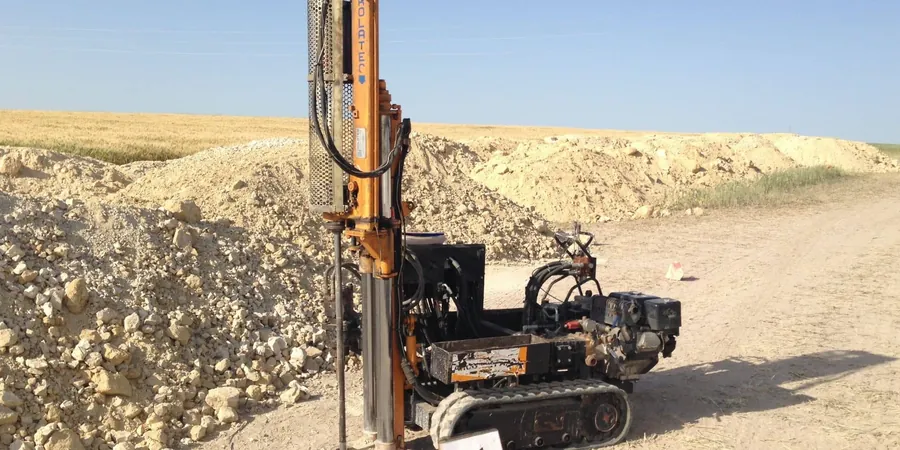
A developer on West Broadway recently faced a 10-meter excavation into glacial advance outwash. The geotechnical report estimated permeability at 10^-5 m/s based on grain-size correlations, but the water inflow during shoring installation told a different story. A Lugeon test was run in the underlying sandstone bedrock, revealing a fracture zone with permeability two orders of magnitude higher than the intact rock matrix. The test procedure isolates a section of borehole with a pneumatic packer, then injects water at stepped pressures while recording flow rates. The Lefranc method, used in the overburden, employs a simple cavity in the soil at the test depth—either a constant head or falling head configuration depending on expected permeability. This direct measurement avoids the scaling errors inherent in lab permeability tests on small specimens. The resulting data allowed the contractor to redesign the dewatering system with targeted well points around the fracture zone, rather than a blanket approach. In Vancouver's glacial stratigraphy, where sands and silts are interlaced with cobble layers, this test is often the only way to characterize preferential flow paths before the first shovel hits the ground.
Field Permeability Testing (Lefranc/Lugeon) in Vancouver
Technical reference — Vancouver

Local considerations

The Granville Street corridor was built on buried creeks and filled ravines during Vancouver's early expansion. Those historical watercourses now form preferential seepage paths that surprise foundation contractors. A single uncharacterized sand lens connecting to False Creek can deliver a steady 50 liters per minute into an excavation, overwhelming sump pumps and destabilizing slope cuts. In rock, the Lugeon value quantifies this risk: values above 5 Lu indicate rock mass permeability sufficient to require systematic grouting. Below 1 Lu, the rock is effectively watertight. Vancouver's Coast Range plutonic rocks often present low matrix permeability but high fracture conductivity, a contrast that only in-situ testing resolves. Without this data, dewatering systems are under-designed, and the risk of basal heave or piping at the excavation base increases sharply. The field permeability test is not a supplementary item on the scope—it is the direct measurement that validates every assumption in the groundwater control plan.

Need a geotechnical assessment?

Reply within 24h.

Email: contact@geotechnicalengineering.vip

Applicable standards

ASTM D4630-19: Standard Test Method for Determining Transmissivity and Storage Coefficient of Low-Permeability Rocks by In Situ Measurements Using the Constant Head Injection Test, ASTM D6391-11: Standard Test Method for Field Measurement of Hydraulic Conductivity Using Borehole Infiltration, ISRM Suggested Method for Lugeon Test, EN ISO 22282-2:2012: Geotechnical investigation and testing — Geohydraulic testing — Part 2: Water permeability tests in a borehole using open systems

Technical parameters

ParameterTypical value
Test standard (Lugeon)ASTM D4630-19, ISRM Suggested Method
Test standard (Lefranc)ASTM D6391-11, AFNOR NF P94-132
Borehole diameterNQ to HQ (76-96 mm) for packer sealing
Test section length0.3 m to 5.0 m, single or double packer
Pressure stages (Lugeon)5-step cycle, max 1 MPa or formation limit
Permeability range (Lefranc)10^-7 to 10^-3 m/s in granular soils
Interpretation methodHvorslev shape factor, steady-state analysis
Reporting metricLugeon value (Lu) or hydraulic conductivity k (m/s)

Frequently asked questions

When does a Lugeon test give better data than a lab permeability test on a core sample?

Lab tests measure the intact rock matrix permeability, typically in the range of 10^-9 to 10^-7 m/s for Vancouver's granitic rocks. A Lugeon test measures the rock mass permeability, including fracture networks that can conduct water at rates 100 to 10,000 times higher. If the rock has any jointing, weathering, or shear zones—common in the Coast Range batholith—the lab value is irrelevant for dewatering design. The Lugeon test captures the hydraulic behavior of the formation at the scale that matters for construction.

How long does a field permeability test take on a Vancouver site?

A single Lefranc test in soil typically requires 45 to 90 minutes, including time for the water level to stabilize. A Lugeon test with the full five-step pressure cycle takes 60 to 120 minutes per test interval, depending on the rock's permeability and how quickly steady flow is achieved at each pressure step. We run these tests immediately after drilling, so they add minimal time to the overall site investigation program.

What is the cost range for Lefranc and Lugeon testing in the Vancouver area?

Field permeability testing in the Vancouver area typically ranges from CA$980 to CA$1.630 per test interval, depending on depth, access conditions, and whether a single or double packer setup is required. A complete program with multiple test depths provides the data needed for reliable dewatering design and groundwater control planning.

Can the Lefranc test be run in the same borehole as an SPT or CPT sounding?

The Lefranc test is run in a borehole, so it can follow an SPT sampling run in the same hole if the casing is advanced appropriately. CPT soundings push a cone without leaving an open hole, so a separate borehole is needed for the permeability test at the CPT location. We coordinate the drilling sequence so that the permeability test is performed in a freshly drilled section with minimal disturbance from drilling fluids, which is critical for accurate results.

Location and service area

We serve projects across Vancouver and its metropolitan area.

View larger map