GEOTECHNICALENGINEERING
VANCOUVER
HomeLaboratoryTriaxial test

Triaxial Testing in Vancouver: Shear Strength Parameters for Foundation Design

Knowledgeable. Thorough. Resourceful.

LEARN MORE

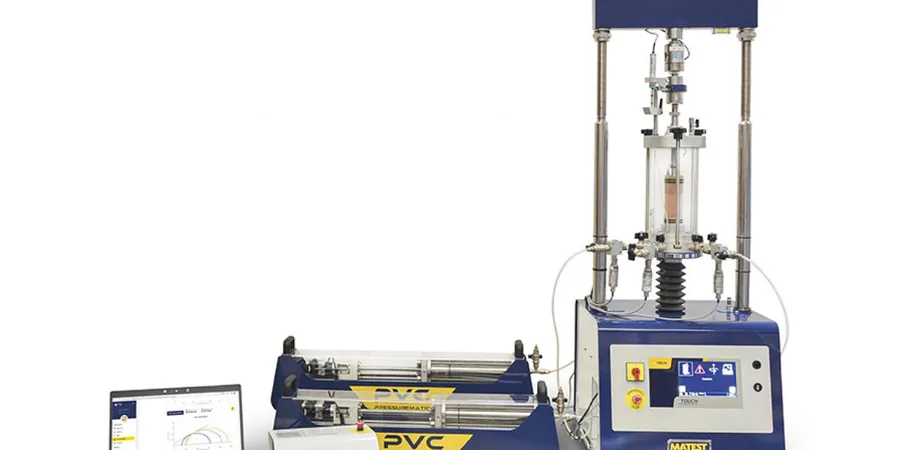
Vancouver sits on a complex geological puzzle—receding glaciers carved its landscape just 10,000 years ago, leaving behind a patchwork of dense tills, marine silts, and liquefiable sands. When a high-rise goes up in False Creek or a bridge abutment is planned near the Fraser River, the effective stress parameters of the ground become non-negotiable. A standard penetration test won’t give you that data. That’s where a properly instrumented triaxial test program makes the difference between a foundation that settles predictably and one that surprises everyone. Our lab runs consolidated-undrained and consolidated-drained triaxial tests on undisturbed Shelby tube samples retrieved from depths exceeding 30 meters. We’ve processed specimens from the glacial till that underlies the Oakridge redevelopment and the sensitive marine clay near the Burrard Inlet. For projects needing a wider picture of the soil profile, we often pair the triaxial campaign with CPT testing to correlate sleeve friction and pore pressure readings with lab-measured friction angles.

A CU triaxial test with pore pressure measurement reveals the soil’s true undrained shear strength—something no index test can deliver.
Our service areas

Methodology and scope

The National Building Code of Canada references CSA A23.3 for concrete structures, but the geotechnical input that feeds those designs must comply with ASTM D4767 for CU triaxial and ASTM D2850 for UU tests. In Vancouver’s seismic setting—a city that experienced a M6.1 crustal quake in 1946 and faces a 1-in-475-year subduction event—cyclic triaxial data often govern the design. Our lab runs multi-stage CU triaxial programs with pore pressure measurement, generating Mohr-Coulomb envelopes that feed directly into Plaxis and FLAC models. We’ve seen effective friction angles for local glacial till range from 32° to 38°, depending on overconsolidation ratio. The triaxial equipment applies back-pressure saturation to achieve B-values above 0.95, ensuring that measured undrained shear strengths reflect true in-situ conditions. For excavation projects near the Pemberton Avenue corridor, we’ve combined triaxial results with slope stability analysis to verify temporary cut inclinations in overconsolidated clay.
Triaxial Testing in Vancouver: Shear Strength Parameters for Foundation Design
Technical reference — Vancouver

Local considerations

Vancouver’s glacial till is stiff—sometimes too stiff for thin-walled Shelby tubes to penetrate without disturbance. Sample disturbance masks true preconsolidation pressure, leading to underestimation of undrained shear strength. We counter this by measuring strain energy at peak and comparing it to reconsolidated specimens. Another risk sits in the marine clay layers found in the Lulu Island and Richmond areas. These deposits carry high sensitivity; a triaxial test that fails to replicate in-situ stress paths will overpredict factor of safety. Our lab applies K₀-consolidation when the project demands it, matching the lateral earth pressure coefficient of the deposit. The biggest design mistake we see is using UU data for long-term drained analysis—a path that ignores pore pressure dissipation and overestimates stability in cut slopes. In a city where the water table sits barely 2 meters below grade in many neighborhoods, drained strength governs the permanent condition.

Need a geotechnical assessment?

Reply within 24h.

Email: contact@geotechnicalengineering.vip

Applicable standards

ASTM D4767-11: Standard Test Method for Consolidated Undrained Triaxial Compression Test for Cohesive Soils, ASTM D2850-15: Standard Test Method for Unconsolidated-Undrained Triaxial Compression Test on Cohesive Soils, CSA A23.3: Design of Concrete Structures (geotechnical parameter interface), NBCC 2020: National Building Code of Canada (seismic site classification links to triaxial-derived Vs and strength)

Technical parameters

ParameterTypical value
Test protocols offeredUU (ASTM D2850), CU (ASTM D4767), CD, multi-stage CU
Specimen diameter35 mm, 50 mm, 70 mm (Shelby tube dependent)
Back-pressure saturation targetB-value ≥ 0.95 (Skempton parameter)
Consolidation stress range50 kPa to 1,200 kPa (covers 0-80 m depth in Vancouver basin)
Shear rate for CU tests0.01 to 0.05 mm/min (pore pressure equalization controlled)
Output parametersc’, φ’, c_u, E_50, pore pressure coefficient A_f
Sample preservationControlled humidity and temperature (7°C) from extrusion to testing

Frequently asked questions

How long does a complete triaxial test program take for a Vancouver project?

A standard CU triaxial test runs 5 to 7 working days from extrusion to report, including saturation, consolidation, and shear stages. A multi-stage CU may extend to 8 days. We batch specimens to reduce calendar time when the drilling program delivers multiple Shelby tubes simultaneously.

What does triaxial testing cost in Vancouver?

A single UU test typically ranges from CA$380 to CA$520, while a full CU triaxial with pore pressure measurement falls between CA$2,540 and CA$3,640 depending on confining stress levels and whether it’s a single-stage or multi-stage program. We provide lump-sum quotes for multi-specimen campaigns.

Can you run triaxial tests on granular soils like the Fraser River sands?

Yes, but sample preparation differs. Reconstituted specimens are compacted to target relative density and tested as CU or CD. For undisturbed sands, we rely on frozen sampling techniques or gel-push methods to preserve structure before triaxial compression.

What B-value do you target for saturation and why does it matter?

We target a B-value of 0.95 or higher per ASTM D4767. This ensures pore pressure response during undrained shear is reliable. Low B-values indicate incomplete saturation, which compresses pore air and masks true undrained strength—a serious error in Vancouver’s sensitive marine clays.

Location and service area

We serve projects across Vancouver and its metropolitan area.

View larger map