GEOTECHNICALENGINEERING
VANCOUVER
HomeGeophysicsMASW / VS30 (shear wave velocity)

MASW Testing & VS30 Shear Wave Velocity for Seismic Site Classification in Vancouver

Knowledgeable. Thorough. Resourceful.

LEARN MORE

Vancouver grew up fast on a tricky geological stage—where glaciomarine silts and dense till sit cheek by jowl with loose Fraser River sands. The city’s 1990s condo boom pushed towers onto soils that had never carried more than a three-story walk-up, and seismic code started biting hard. Today, any mid-rise or institutional building here needs a defensible site class under NBCC 2020, and that’s where a proper shear wave velocity profile comes in. We run MASW arrays across parking lots, vacant lots, and tight urban sites to nail down the VS30 number that governs your base shear. It’s fast, it’s non-invasive, and when paired with a few well-placed SPT boreholes, it gives structural engineers exactly what they need to trim seismic demand or confirm that a stiffer site class is justified.

A defensible VS30 value under NBCC 2020 can make the difference between a Site D and Site E classification—and that difference can save real dollars in lateral design.
Our service areas

Methodology and scope

Vancouver’s winter rains saturate the upper few metres and completely change near-surface stiffness seasonally—a dry August profile can look like a different site than a soggy February one. We’ve learned the hard way to schedule MASW surveys here with an eye on the weather, because a waterlogged crust can knock VS30 down half a class if you’re not careful. Our crew uses a 24-channel seismograph with 4.5 Hz geophones and a 10 kg sledge source, laying out spreads from 46 to 92 metres depending on target depth. Dispersion curves get inverted with a solid initial model constrained by local geology, and we cross-check results against any available CPT soundings or downhole data. For sites in Richmond’s deltaic silts, we typically extend the array to capture the deep soft layer that controls site amplification. Every report includes Vs profiles, VS30 calculation, and a clear NBCC site class recommendation—Site C, D, or E, with the backup data to prove it.
MASW Testing & VS30 Shear Wave Velocity for Seismic Site Classification in Vancouver
Technical reference — Vancouver

Local considerations

NBCC 2020 ties seismic design forces directly to site class, and Vancouver sits in a high-hazard zone where the spectral acceleration values are among the highest in Canada. Getting the classification wrong means you either over-design and waste money, or under-design and carry liability nobody wants. The biggest trap we see is developers relying on a single SPT boring and a generic correlation to estimate VS30—those correlations were never calibrated for Vancouver’s glacial stratigraphy and can easily misclassify a Site D as Site E. A direct MASW measurement removes the guesswork. In areas like the Fraser River delta, where deep soft clays extend well past 30 metres, site amplification can be severe, and the difference between a conservative and an accurate VS30 can shift the entire lateral-force-resisting system design. Our reports are signed by a professional engineer registered with Engineers and Geoscientists BC, and they stand up to plan-check scrutiny.

Need a geotechnical assessment?

Reply within 24h.

Email: contact@geotechnicalengineering.vip

Applicable standards

NBCC 2020 Division B, Section 4.1.8, ASTM D7400-17 Standard Guide for MASW, ASCE/SEI 7-22 Chapter 20 (Site Classification), CSA A23.3-19 Annex A (seismic provisions)

Technical parameters

ParameterTypical value
Test methodMASW (Multichannel Analysis of Surface Waves), active source
Applicable standardASTM D7400-17, NBCC 2020 Table 4.1.8.4.A
Vs30 depth of investigation30 metres below ground surface
Typical array length46 m to 92 m (24-channel spread)
Source type10 kg sledgehammer on aluminium plate
Geophone frequency4.5 Hz vertical-component
Sampling interval0.25 ms or 0.5 ms, site-dependent
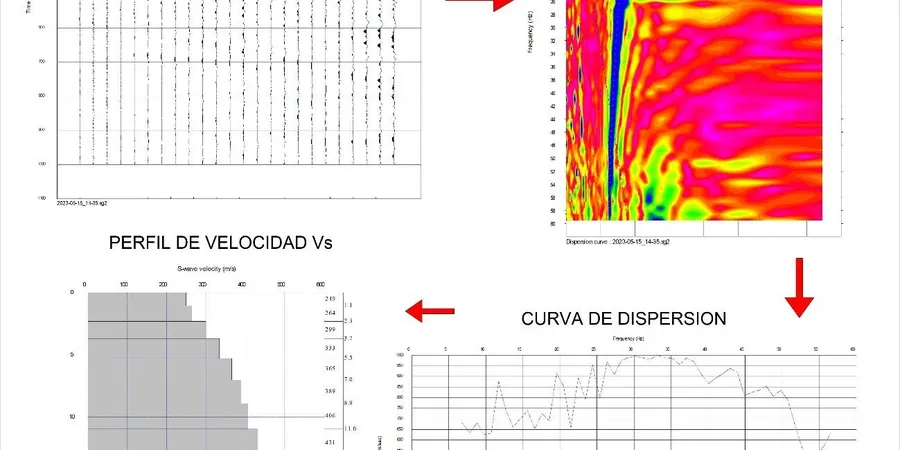
DeliverablesVs profiles, VS30 value, NBCC site class, dispersion curves

Frequently asked questions

How much does a standard MASW survey for VS30 cost in Vancouver?

A single-array MASW survey for NBCC site classification in Metro Vancouver typically runs between CA$2,590 and CA$3,920, depending on array length, site access, and whether we need to correlate with existing borehole data. Tight urban sites with limited laydown space may push toward the upper end. We provide a firm quote after a site walk or a review of your geotechnical report.

Does MASW work on paved urban sites in Vancouver?

It does, and most of our Vancouver surveys are run on asphalt or concrete. We couple the geophones with plaster or use spike bases through thin asphalt. The bigger constraint is space—we need a clear linear spread of 46 to 92 metres. For tight downtown lots, we often shoot diagonally across the property, and occasionally we use a shorter array with higher-frequency geophones to trade depth for resolution.

Can MASW replace a borehole for site classification?

MASW gives you a direct VS30 measurement and a reliable site class, which is what the structural engineer needs for base shear. It doesn't replace the borehole for soil description, groundwater monitoring, or liquefaction assessment. Most Vancouver projects use MASW alongside one or two SPT boreholes—the combination gives you the complete geotechnical picture and satisfies both the geotechnical and structural code requirements.

How long does a MASW survey take and when do I get the report?

Fieldwork for a single array is typically done in half a day, including setup, multiple shot records, and breakdown. We process the dispersion curves and run the inversion within three to five business days. The final report, signed by a P.Eng., is usually in your inbox inside a week. For rush projects, we can turn around preliminary VS30 numbers in 48 hours.

Location and service area

We serve projects across Vancouver and its metropolitan area.

View larger map