GEOTECHNICALENGINEERING
VANCOUVER
HomeInvestigationExploratory test pit

Exploratory Test Pits for Vancouver Subsurface Investigations

Knowledgeable. Thorough. Resourceful.

LEARN MORE

Vancouver's complex glacial and post-glacial geology, shaped by the Fraser River and Cordilleran ice sheet, demands direct observation during site characterization. The NBCC 2020 requires that geotechnical investigations account for the city's variable deposits—from Vashon till to modern alluvial silts—and exploratory test pits remain the most reliable method for exposing shallow stratigraphy in accessible areas. When borehole data leaves questions about fill thickness or lens geometry in neighborhoods like Mount Pleasant or Kitsilano, an open excavation logged per ASTM D2488 provides the visual certainty that indirect methods cannot match. For deeper profiling beyond the reach of a test pit, our team integrates spt drilling to extend the stratigraphic model into the bearing stratum.

Direct observation of Vancouver's glacial till, fill, and buried organics removes the interpretation gap that geophysics alone leaves open.
Our service areas

Methodology and scope

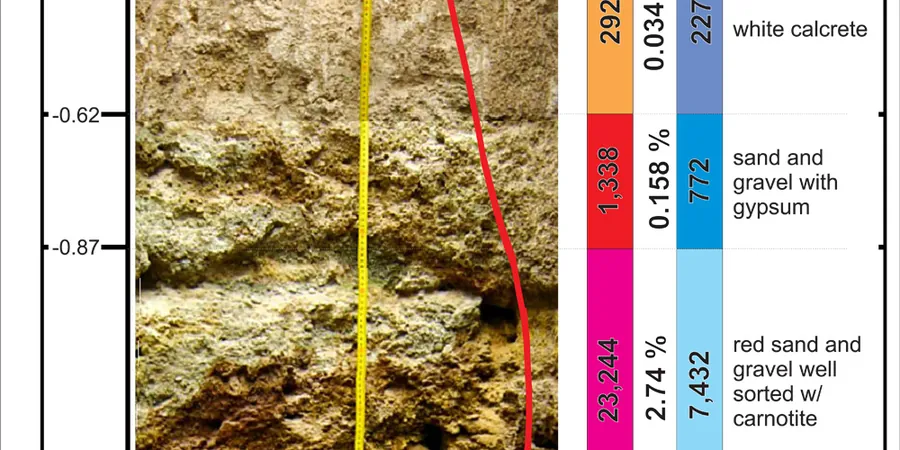
A recent project on a Commercial Drive infill site illustrates the value of this approach. The surface appeared uniform, but three exploratory pits spaced across the lot revealed a buried peat lens at 1.8 m depth, confined to the eastern third of the property—a remnant of a filled-in stream channel that predates the 1920s subdivision. The excavation exposed the contact between imported gravel fill and the native Queenston till, allowing our engineer to measure the organic layer thickness directly and collect undisturbed block samples for laboratory atterberg limits testing. In Vancouver's temperate rainforest climate, where seasonal groundwater fluctuates within the upper two meters, staging a test pit also lets us document seepage patterns, root penetration, and the oxidation state of the till matrix—details that inform both bearing capacity and sulfate exposure class per CSA A23.3. When the stratigraphy suggests compressible layers, we may recommend a cpt test to obtain a continuous tip resistance profile across the soft zone before finalizing the foundation elevation.
Exploratory Test Pits for Vancouver Subsurface Investigations
Technical reference — Vancouver

Local considerations

The contrast between Vancouver's west side and the Fraser River floodplain is stark when it comes to test pit risk. In Point Grey and Dunbar, excavations encounter stiff Vashon till that stands near-vertically for short periods, allowing a focused logging window. Move south to the Marpole or Sunset neighborhoods, and the same pit depth cuts through soft, normally consolidated Fraser River silts that require immediate shoring or a benched slope of 1.5H:1V to prevent sloughing. The greatest hazard is encountering unanticipated fill—historic ash and rubble from the 1886 fire, or sawdust from early mill operations along False Creek—that collapses without warning. A pre-excavation review of City of Vancouver historical permits and fire insurance maps flags these zones, and we stage the pit in short lifts with continuous inspection to protect crew and preserve the face for logging.

Need a geotechnical assessment?

Reply within 24h.

Email: contact@geotechnicalengineering.vip

Applicable standards

ASTM D2488-17 (Visual-Manual Description), NBCC 2020 – Section 4.2 Foundations, CSA A23.3:19 (Sulfate exposure from soil), WorkSafeBC OHS Regulation Part 20 (Excavations)

Technical parameters

ParameterTypical value
Maximum practical depth (safe slope)3.5–4.0 m (Type 3 soil per WorkSafeBC)
Standard pit dimensions1.2 m wide x 2.5–3.5 m long
Logging standardASTM D2488 (visual-manual) + D2487 (USCS)
Typical logging detailUnit contacts, moisture, consistency, color (Munsell), fabric, clast lithology
Sampling methodsBlock samples, bulk bags (25 kg), Shelby tubes pushed from pit floor
Groundwater documentationSeepage elevation, rate, pH and conductivity field readings
Backfill specification complianceMethod statement per City of Vancouver Street & Traffic Bylaw

Frequently asked questions

How much does an exploratory test pit cost in Vancouver?

For a standard pit to 3.5 m depth with logging, sampling, and backfill, budgets typically fall between CA$740 and CA$1,300. The final figure depends on access constraints, shoring requirements, and the number of samples collected for lab testing.

What depth can you reach with a test pit in Vancouver?

Practical depth is governed by WorkSafeBC soil classification. In competent Vashon till (Type 2 soil), we can reach 3.5–4.0 m with sloped sides. In soft Fraser River silts or fill (Type 3), depth is limited to about 2.5 m unless hydraulic shoring is installed.

Do I need a city permit for a test pit on private property?

If the excavation is entirely within private property and does not intercept the right-of-way, a City of Vancouver permit is generally not required. Pits in the boulevard or lane require a Street Use Permit, and we manage that application as part of the scope.

Can a test pit replace a borehole for foundation design?

A test pit provides excellent data for shallow foundations, but NBCC 2020 requires knowledge of deeper strata. We typically combine exploratory pits for the upper 3–4 m with SPT drilling or CPT sounding to characterize the bearing layer at depth, especially where glacial till overlies sedimentary rock.

Location and service area

We serve projects across Vancouver and its metropolitan area.

View larger map